
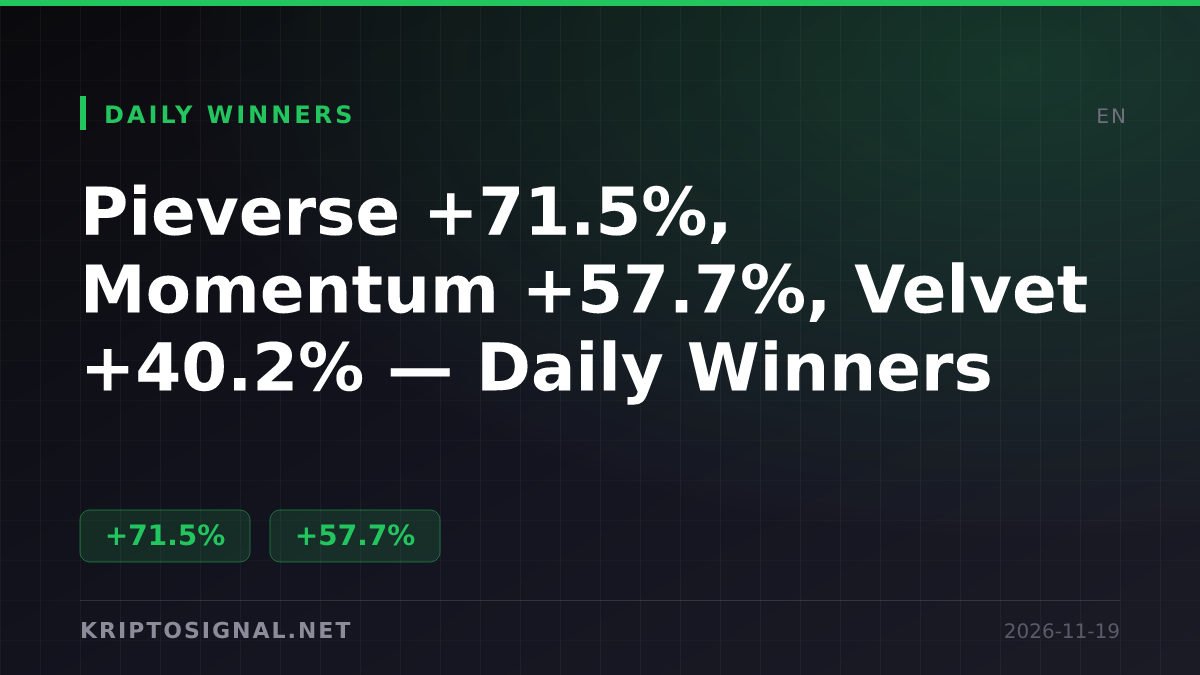
Pieverse jumped 71.5% to $3.53 in 24 hours and briefly touched $3.64 — which happens to be the token’s all-time high. The backdrop was anything but friendly: total crypto market capitalization fell 4.4% to $2.18 trillion, Bitcoin lost 2.8% to $63,071 and Ethereum slipped to $1,777. When the index drops and a single token rises 70%, the cause is rarely “the market” — it is almost always one project and one order book.
Today’s three gainers share little beyond direction: payment infrastructure, a Sui-based exchange and an on-chain asset management platform. They also share one uncomfortable trait — all three sit far below their all-time highs, which makes the move a recovery rather than a new cycle peak.
Pieverse: +71.5% with the record within reach
What is Pieverse?
Pieverse is a payments infrastructure project built on BNB Chain, built around the thesis that time itself can be traded as an asset — hence the “timeFi” label the team gave itself. In practice it is a settlement layer for on-chain payments, with an emphasis on transactions initiated by software agents rather than humans signing every transfer by hand. The project drew attention through Binance’s early-access program, which handed it both distribution and an audience — two things worth more in crypto than any white paper.
The supply is a familiar shape: one billion tokens total, 274.75 million circulating. A small float explains much of the volatility. When fresh demand arrives while only a quarter of supply sits on the sell side, price does not drift — it jumps.
Why is it rising?
Daily volume of $105 million against a $969 million market cap is solid but not extreme. The geometry is far more interesting: price spent the session pinned just under $3.64, the all-time high, inside a daily range of $2.05 to $3.64. A market testing its own record behaves like a tennis player on match point — every point counts double and every miss hurts more. A breakout opens space with no historical resistance; a rejection draws a double top and sends price back into the range.
The longer context sharpens the picture. The all-time low of $0.119 was recorded on November 14, 2025 — exactly one year before this move — and price is now close to thirty times that level. A path from floor to record in twelve months is not unusual in crypto, but it is unusual without a single drawdown deeper than 60%, which suggests most of the distance was covered in a few violent impulses rather than a calm trend.
Data: price $3.53 · 24h +71.5% · market cap $969.0M · 24h volume $105.0M · circulating supply 274.75M (1B total) · ATH $3.64 · ATL $0.119 (Nov 14, 2025)
Momentum: +57.7% off a four-day-old floor
What is Momentum?
Momentum is a decentralized exchange on Sui, written in Move, running a ve(3,3) incentive model — the same template exchanges on other chains have used for years. The logic is simple and slightly cynical: traders earn incentives for volume, those who lock tokens earn voting power and a share of fees, and the protocol hopes one group keeps funding the other long enough for real liquidity to appear. Much of DEX history compresses into one sentence: incentives leave, liquidity stays or it does not.
Momentum has played the concentrated-liquidity card from the start, which helps on tight-range pairs and hurts when a single large order arrives. On Sui, a chain that has grown into a serious DeFi hub over the past few years, that position makes sense — at a price paid in volatility.
Why is it rising?
Volume of $342 million in 24 hours against a $46.6 million market cap is one of the largest turnovers in the top 500. When daily volume exceeds market cap sevenfold, the market is not accumulating — it is fighting. Price hit an all-time low of $0.095 on November 14, the classic outcome of early-holder distribution or an unlock, and four days later it trades at $0.228.
That arc from floor to double in four sessions is a textbook squeeze: shorts piled up at the lows and were then forced to close at a loss, pushing price higher. The daily range of $0.133 to $0.280 shows there was room to double inside a single session — rarely a good sign for anyone buying the top.
Scale matters here. The token sits 94% below its $4.03 all-time high. A 57% rally sounds impressive until the chart from listing to today is taken in, where the same move looks like a small bump on a long downhill road. Incentives set the direction, not fundamental demand for the exchange.
Data: price $0.2282 · 24h +57.7% · market cap $46.6M · 24h volume $342.5M · circulating supply 204.1M (1B total) · ATH $4.03 · ATL $0.0953 (Nov 14, 2026)
Velvet: +40.2% on a thin order book
What is Velvet?
Velvet is an on-chain asset management platform — a place where strategies, portfolios and other people’s treasuries are packaged into a single token and traded without asking permission. The idea is as old as DeFi itself: why manage a position by hand when a share of someone else’s portfolio can be bought instead, leaving the worrying to them. Velvet tried to turn that concept into a multi-chain product with a healthy dose of automation.
The model carries a built-in irony: a platform that lets people manage other people’s money lives and dies on trust. When the market drops 4%, the question is not how good a strategy is, but how many holders are willing to leave capital inside.
Why is it rising?
Honesty is required here: $3.7 million in volume against a $36.5 million market cap is thin. A 40% gain was achieved on an order book that cannot absorb a serious order, and the daily range of $0.0546 to $0.0703 shows price cleared the earlier session high without much of a fight. That is a low-liquidity rally, not institutional accumulation.
The context is almost poignant: the $2.08 all-time high now sits 96% above the current price, while the all-time low of $0.0413 was set in July 2025. The token has spent more than a year in the basement of its own chart and is now trying to climb the stairs. Moves like this tend to last until the first larger seller arrives.
Data: price $0.07695 · 24h +40.2% · market cap $36.5M · 24h volume $3.7M · circulating supply 473.9M (1B total) · ATH $2.08 · ATL $0.0413 (Jul 10, 2025)
Three tokens, three different reasons to rise, and one shared warning: every one of these moves happened while the market was losing 4.4%. Once the index stabilizes, attention moves on, and whatever is left behind usually gets called a correction.
Disclaimer: this is not investment advice. The crypto market is highly volatile and the data above reflects the situation at the time of writing (19 November 2026, 00:00 UTC).
Read next: Brevis -27.4%, Manadia -17.4%, Centrifuge -14.6% — Daily Losers